Выбор навыков для ИИ-агентов
Picks at most one skill for an agent turn out of the 182 in Nous Research's Hermes catalog: one TypeSafe request ranks every skill and asks whether the turn needs one at all, a second reads the top three properly and can reject all of them. The winner's name goes into a single line of the agent's sy…
Выбирает не более одного навыка для шага агента из 182 доступных в каталоге Hermes от Nous Research: один запрос TypeSafe ранжирует все навыки и определяет, требуется ли навык вообще, второй запрос подробно анализирует топ-3 и может отклонить их все. Имя победителя добавляется в единственную строку системного промпта агента, снижая более чем вдвое как число ошибочно загруженных навыков, так и загрузки в ситуациях, когда ни один навык не подходит.
Агенты обычно выбирают навыки, усекая их описания и загружая весь список в системный промпт, что увеличивает затраты, снижает точность выбора навыка и приводит к деградации контекста (context rot) на всю оставшуюся сессию. Мы решаем эту проблему, используя два запроса TypeSafe на каждый шаг агента — один для ранжирования навыков и второй для проверки выбора, сокращая количество некорректных загрузок навыков более чем вдвое.
Агент с большим каталогом навыков принимает решение практически вслепую. Каталог поступает к нему в виде индекса: одна строка на навык, при этом описание обрезается, чтобы полный текст не вытеснял саму беседу. Фреймворк Hermes, используемый здесь в качестве агентной среды, по умолчанию обрезает описание до 60 символов. Например, при такой длине навык, который редактирует файлы .pptx, выглядит почти так же, как навык, который создает их с нуля. Попросите подготовить питч-дек, и агент легко может загрузить не тот инструмент. А на шаге, где ни один навык вообще не нужен, он все равно может что-то загрузить, поскольку список названий провоцирует на угадывание.
В этом руководстве описания не сокращаются: вместо этого применяется принцип поэтапного раскрытия (progressive disclosure) — сначала недорогой обзор всех 182 навыков, а затем детальное изучение трех кандидатов. Перед принятием решения о загрузке навыка выполняются два запроса TypeSafe. Первый ранжирует все навыки каталога относительно запроса пользователя и определяет, нужен ли навык вообще. Второй заново оценивает только трех лидеров — теперь уже с их полными описаниями и началом инструкций — и имеет возможность отклонить их все.
Имя победителя подставляется в одну дополнительную строку системного промпта агента на текущем шаге:
<skill_relevance>
Relevant to the current request: pptx-author. Ignore this if it does not fit what the user
actually asked for.
</skill_relevance>
Агент сохраняет свой полный индекс и свободу собственного суждения, а эта строка лишь подсказывает ему, на какую запись обратить внимание в первую очередь. Сам каталог в промпте никогда не меняется, благодаря чему кэширование префикса (prefix caching) сохраняется в полной мере. Результаты на 488 запросах к модели claude-haiku-4-5-20251001 с использованием навыков из каталога Hermes:
| загружает неверный навык | загружает навык, когда ничего не подходит | |
|---|---|---|
| агент сам по себе, только со своим каталогом | 16.8% | 9.8% |
| агент с подсказкой TypeSafe | 7.3% | 4.0% |
| агенту передан правильный ответ (oracle) | 2.5% | 1.2% |
Третья строка показывает, что базовый уровень ошибок не равен нулю: даже получив абсолютно точный навык, агент не всегда загружает его, и никакой метод подбора, сколь бы совершенен он ни был, не может преодолеть этот порог.
В итоге вы получаете функцию suggest(), возвращающую не более одного имени навыка, функцию suggestion_block(), форматирующую подсказку для системного промпта, и тестовый стенд, на котором получена таблица выше, готовый к работе с вашим собственным каталогом.
flowchart LR
    subgraph C1["Вызов 1 — беглый обзор всех 182 навыков"]
        direction TB
        Q1["<b>Choice:</b> какой навык подходит?<br/><i>все 182, по одной строке на каждый</i>"]
        N1["<b>Nouls:</b> нужен ли навык вообще?<br/>· воздействовать на данные пользователя?<br/>· следовать инструкциям?<br/>· или просто пообщаться?"]
        %% invisible link: without an edge these two share a rank, which in a TB
        %% subgraph puts them side by side instead of stacked
        Q1 ~~~ N1
    end
    subgraph C2["Вызов 2 — детальный анализ этих 3"]
        direction TB
        Q2["<b>Choice:</b> какой из 3?<br/><i>с подробными описаниями</i>"]
        N2["<b>Nouls:</b> действительно ли каждый<br/>решает задачу?"]
        Q2 ~~~ N2
    end
    REQ["запрос пользователя"] --> C1
    C1 -->|"топ-3"| C2
    C1 -->|"ничего<br/>не подходит"| STOP["ничего не<br/>предлагать"]
    C2 -->|"никто не подошел"| STOP
    C2 -->|"есть победитель"| OUT["предложить<br/>победителя"]
Настройка
- Установите клиент TypeSafe, клиент Anthropic и вспомогательные модули руководства.
- Задайте ключ API TypeSafe и ключ Anthropic для тестируемого агента.
pip install anthropic matplotlib ipython "typesafe-sdk>=0.5.7" cooksafe --extra-index-url https://pypi.typesafe.ai/
export TYPESAFE_API_KEY=your-key-here
export ANTHROPIC_API_KEY=your-key-here
Примечание: блоки кода ниже представляют собой единый скрипт. Чтобы выполнить его самостоятельно, сохраните их в один файл в указанном порядке.
Кэширование результатов
JsonCache сохраняет результаты каждого вызова по ключу входных данных, поэтому повторный запуск воспроизводит приведенные ниже цифры без обращения к API. Удалите json_cache.json, чтобы выполнить прогон в реальном времени. Опубликованный прогон использовал jev-1.12 и claude-haiku-4-5-20251001, выборка от 31.07.2026.
import json
import os
from collections import defaultdict
from concurrent.futures import ThreadPoolExecutor
from pathlib import Path
from time import perf_counter

import anthropic
import matplotlib
import matplotlib.pyplot as plt
from matplotlib.ticker import PercentFormatter
from cooksafe import JsonCache, make_playground_link
from IPython.display import Markdown, display
from typesafe_sdk import Choice, Noul, TypeSafeClient

matplotlib.use("Agg")  # headless render

TYPESAFE_MODEL = "jev-1.12"
AGENT_MODEL = (
    "claude-haiku-4-5-20251001"  # the agent under test, pinned so scores are stable
)

SHORTLIST = 3  # candidates carried from the first request into the second
EXCERPT_CHARS = (
    700  # SKILL.md characters each candidate brings; the roster file stores 1600
)
GATE_THRESHOLD = (
    0.30  # mean of the three request nouls, below which nothing is suggested
)
FITS_THRESHOLD = (
    0.30  # a shortlist whose best "does this fit" noul is under this is dropped
)
WORKERS = 8  # small pool: enough to keep a live run to minutes, gentle on rate limits

assert EXCERPT_CHARS <= 1600, (
    "the shipped roster file stores 1600 body characters per skill"
)

client = TypeSafeClient(
    api_key=os.environ.get(
        "TYPESAFE_API_KEY", "cache-only"
    ),  # keyless kernels replay the cache
    base_url=os.environ.get("TYPESAFE_ENDPOINT"),
    timeout=120.0,
)
agent = anthropic.Anthropic(api_key=os.environ.get("ANTHROPIC_API_KEY", "cache-only"))
json_cache = JsonCache(Path("json_cache.json"))
Шаг 1: загрузка каталога
Файл hermes_roster.json содержит 182 навыка из
NousResearch/hermes-agent (MIT) на определенном
коммите. Каждая запись содержит имя и категорию навыка, краткое описание для индекса,
полное описание и начало файла SKILL.md.
Приведенный ниже индекс и инструкции промпта над ним скопированы непосредственно из Hermes.
ROSTER = json.loads(Path("hermes_roster.json").read_text(encoding="utf-8"))
BY_NAME = {skill["name"]: skill for skill in ROSTER}

# Verbatim from hermes-agent agent/prompt_builder.py:build_skills_system_prompt.
PREAMBLE = (
    "## Skills (mandatory)\n"
    "Before replying, scan the skills below. If a skill matches or is even partially relevant "
    "to your task, you MUST load it with skill_view(name) and follow its instructions. "
    "Err on the side of loading — it is always better to have context you don't need "
    "than to miss critical steps, pitfalls, or established workflows. "
    "Skills contain specialized knowledge — API endpoints, tool-specific commands, "
    "and proven workflows that outperform general-purpose approaches. Load the skill "
    "even if you think you could handle the task with basic tools like web_search or terminal. "
    "Skills also encode the user's preferred approach, conventions, and quality standards "
    "for tasks like code review, planning, and testing — load them even for tasks you "
    "already know how to do, because the skill defines how it should be done here.\n"
    "Whenever the user asks you to configure, set up, install, enable, disable, modify, "
    "or troubleshoot Hermes Agent itself — its CLI, config, models, providers, tools, "
    "skills, voice, gateway, plugins, or any feature — load the `hermes-agent` skill "
    "first. It has the actual commands (e.g. `hermes config set …`, `hermes tools`, "
    "`hermes setup`) so you don't have to guess or invent workarounds.\n"
    "If a skill has issues, fix it with skill_manage(action='patch').\n"
    "After difficult/iterative tasks, offer to save as a skill. "
    "If a skill you loaded was missing steps, had wrong commands, or needed "
    "pitfalls you discovered, update it before finishing.\n"
    "\n"
)
FOOTER = "\n\nOnly proceed without loading a skill if genuinely none are relevant to the task."
IDENTITY = (
    "You are Hermes, a capable AI assistant with access to tools and a library "
    "of skills. You help the user with coding, research, and everyday tasks.\n\n"
)


def render_index() -> str:
    """The body of <available_skills>: skills grouped by category, both sorted by name."""
    by_category = defaultdict(list)
    for skill in ROSTER:
        by_category[skill["category"]].append(skill)
    lines = []
    for category in sorted(by_category):
        lines.append(f"  {category}:")
        for skill in sorted(by_category[category], key=lambda s: s["name"]):
            lines.append(f"    - {skill['name']}: {skill['description']}")
    return "\n".join(lines)


CATALOG_PROMPT = (
    IDENTITY
    + PREAMBLE
    + "<available_skills>\n"
    + render_index()
    + "\n</available_skills>"
    + FOOTER
)

widths = [len(skill["description"]) for skill in ROSTER]
print(f"{len(ROSTER)} skills in {len({s['category'] for s in ROSTER})} categories")
print(f"roster prompt: {len(CATALOG_PROMPT):,} characters")
print(
    f"index description: {sum(widths) / len(widths):.0f} characters on average, "
    f"{max(widths)} at most"
)
print("\none category, as the agent reads it:")
index_lines = render_index().splitlines()
start = index_lines.index("  apple:")
end = next(
    i
    for i in range(start + 1, len(index_lines))
    if not index_lines[i].startswith("    ")
)
print("\n".join(index_lines[start:end]))182 skills in 33 categories
roster prompt: 16,089 characters
index description: 54 characters on average, 60 at most
one category, as the agent reads it:
apple:
- apple-notes: Manage Apple Notes via memo CLI: create, search, edit.
- apple-reminders: Apple Reminders via remindctl: add, list, complete.
- findmy: Track Apple devices/AirTags via FindMy.app on macOS.
- imessage: Send and receive iMessages/SMS via the imsg CLI on macOS.Шаг 2: оценка базового агента без подсказок
requests.json содержит 488 одношаговых запросов: 315 из них покрываются ровно одним навыком,
а остальные 173 не покрываются ни одним.
Покрытые запросы были сгенерированы Claude Sonnet 5 на основе файлов SKILL.md каждого навыка,
поэтому разметка надежна, а сами запросы проще реальных пользовательских.
Все 173 непокрытых запроса составлены так, чтобы выявлять ложные срабатывания: 85 повседневных
запросов, 42 технических вопроса, для которых нет навыков (объясни, что такое монада),
и 46 запросов на специфические действия, отсутствующие в каталоге (например, опубликуй это в Mastodon
в каталоге, где есть только интеграция с X).
Оценка учитывает только первый ответ агента. Оба показателя являются долями ошибок, поэтому меньшее
значение лучше:
- wrong load (ошибочная загрузка): доля покрытых запросов, в которых первый вызов
skill_view
загрузил не тот навык. Шаг, на котором ничего не загружено, считается промахом. - needless load (избыточная загрузка): доля непокрытых запросов, в которых агент вообще вызвал
skill_view.
REQUESTS = json.loads(Path("requests.json").read_text(encoding="utf-8"))
POSITIVES = [p for p in REQUESTS if p["gold"]]
NEGATIVES = [p for p in REQUESTS if not p["gold"]]

print(
    f"{len(REQUESTS)} requests: {len(POSITIVES)} covered by a skill "
    f"({len({p['gold'] for p in POSITIVES})} distinct skills), {len(NEGATIVES)} covered by none"
)
print(f"\ncovered   [{POSITIVES[0]['gold']}]  {POSITIVES[0]['text']}")
print(f"uncovered {NEGATIVES[0]['text']}")488 requests: 315 covered by a skill (171 distinct skills), 173 covered by none
covered [1password] I've got a config.yaml with `{{ op://app-prod/db/password }}` placeholders in it — can you set up my project to pull the real values in at runtime instead of hardcoding them?
uncovered Add these three cards to our Trello backlog.Подсказка помещается в отдельный блок системного промпта после каталога, а не внутри него,
благодаря чему текст каталога остается побайтово идентичным на каждом шаге, сохраняя кэширование префикса.
Агент располагает минимальным набором инструментов, включая skill_view для загрузки навыка по
текстовому имени. Для успешной загрузки имя должно точно совпадать с названием навыка.
# Verbatim from hermes-agent tools/skills_tool.py:SKILL_VIEW_SCHEMA.
SKILL_VIEW_DESCRIPTION = (
    "Skills allow for loading information about specific tasks and workflows, as "
    "well as scripts and templates. Load a skill's full content or access its "
    "linked files (references, templates, scripts). First call returns SKILL.md "
    "content plus a 'linked_files' dict showing available references/templates/"
    "scripts. To access those, call again with file_path parameter."
)
TOOLS = [
    {
        "name": "skill_view",
        "description": SKILL_VIEW_DESCRIPTION,
        "input_schema": {
            "type": "object",
            "properties": {
                "name": {"type": "string", "description": "The skill name."}
            },
            "required": ["name"],
        },
    },
    {
        "name": "terminal",
        "description": "Run a shell command on the user's machine and return its output.",
        "input_schema": {
            "type": "object",
            "properties": {"command": {"type": "string"}},
            "required": ["command"],
        },
    },
    {
        "name": "read_file",
        "description": "Read a file from the user's filesystem.",
        "input_schema": {
            "type": "object",
            "properties": {"path": {"type": "string"}},
            "required": ["path"],
        },
    },
    {
        "name": "web_search",
        "description": "Search the web and return result snippets.",
        "input_schema": {
            "type": "object",
            "properties": {"query": {"type": "string"}},
            "required": ["query"],
        },
    },
]


@json_cache
def run_turn(model: str, arm: str, request: str, suggestion: str) -> dict:
    """One measured turn. ``arm`` is in the key so each arm samples independently."""
    system = [
        {"type": "text", "text": CATALOG_PROMPT, "cache_control": {"type": "ephemeral"}}
    ]
    if suggestion:
        system.append({"type": "text", "text": suggestion})  # after the breakpoint
    response = agent.messages.create(
        model=model,
        max_tokens=1024,
        system=system,
        tools=TOOLS,
        messages=[{"role": "user", "content": request}],
    )
    usage = response.usage
    return {
        "loaded": [
            str(block.input.get("name", ""))
            for block in response.content
            if block.type == "tool_use" and block.name == "skill_view"
        ],
        "input_tokens": usage.input_tokens or 0,
        "output_tokens": usage.output_tokens or 0,
    }


def summarise(turns: dict[str, dict]) -> dict[str, float]:
    """Two failure rates: wrong loads on covered requests, needless ones on uncovered."""
    hits = [turns[p["text"]]["loaded"][:1] == [p["gold"]] for p in POSITIVES]
    over = [bool(turns[p["text"]]["loaded"]) for p in NEGATIVES]
    return {
        # both metrics are errors, so the two columns read the same direction
        "wrong_load": 1 - sum(hits) / len(hits),
        "needless_load": sum(over) / len(over),
    }


def run_arm(arm: str, suggestions: dict[str, str]) -> dict[str, dict]:
    """One measured turn per request, in a small pool. 488 calls."""
    texts = [request["text"] for request in REQUESTS]
    with ThreadPoolExecutor(max_workers=WORKERS) as pool:
        turns = pool.map(
            lambda t: run_turn(AGENT_MODEL, arm, t, suggestions.get(t, "")), texts
        )
        return dict(zip(texts, turns))
Сначала агент запускается только со своим каталогом — так, как он работает сегодня. Полученные
две доли ошибок служат базовой линией (baseline), с которой сравниваются остальные результаты.
baseline = run_arm("baseline", {})
base_scores = summarise(baseline)
print(
    f"wrong loads    {base_scores['wrong_load']:.1%}   ({len(POSITIVES)} covered requests)"
)
print(
    f"needless loads {base_scores['needless_load']:.1%}   ({len(NEGATIVES)} uncovered requests)"
)

# where the wrong loads land: a neighbour of the right skill, or somewhere unrelated?
misses = [
    (p["gold"], baseline[p["text"]]["loaded"][0])
    for p in POSITIVES
    if baseline[p["text"]]["loaded"] and baseline[p["text"]]["loaded"][0] != p["gold"]
]
same_category = sum(
    1
    for gold, got in misses
    if got in BY_NAME and BY_NAME[got]["category"] == BY_NAME[gold]["category"]
)
print(
    f"\nof {len(misses)} wrong first picks, {same_category} came from the right skill's own "
    f"category"
)wrong loads 16.8% (315 covered requests)
needless loads 9.8% (173 uncovered requests)
of 36 wrong first picks, 10 came from the right skill's own categoryОшибочные загрузки попадают в ту же категорию, к которой относится правильный навык, несоизмеримо
чаще, чем это происходило бы при случайном выборе: основная сложность заключается в различении
похожих навыков внутри одной темы. Агент уже ищет примерно в правильном месте.
Шаг 3: ранжирование всего каталога
Один запрос объединяет два типа вопросов:
which— вопросChoice
по всем 182 именам навыков с кратким описанием из индекса в качестве критерия каждого
варианта (тот же текст, который видит сам агент). Его вероятности образуют итоговый рейтинг.- три вопроса
Noulо запросе пользователя
(приведены ниже), каждый из которых под своим углом проверяет, требуется ли выполнение конкретного
действия, а не просто разъяснение. Вопросprose_suffices
инвертирован. Их среднее значение определяет, стоит ли вообще предлагать навык: при значении
ниже 0.30 подсказка не формируется.
Оба типа вопросов отправляются в одном запросе, поэтому ранжирование и проверка обходятся в одно
обращение к API.
Формулируйте эти три вопроса так, чтобы они спрашивали о потребности в действии. Вопрос о тематике
текста не отличит задачу «объясни, что такое монада» от запроса, требующего навыка разработки,
поскольку обе темы относятся к программированию.
Один вопрос Choice без труда вмещает каталог такого размера. Для каталогов в разы большего
объема его можно разбить на части, проранжировать каждую и затем применить тот же этап отбора
к лидерам.
CHOICE_INSTRUCTIONS = (
    "Which of these skills, if any, is the right one to load to help with the "
    "user's latest request?"
)
GATE_QUESTIONS = {
    "acts_on_user_system": (
        "Is the assistant being asked to act on the user's files, accounts, devices, "
        "or online services, rather than only to explain or advise?"
    ),
    "would_follow_documented_procedure": (
        "Would a careful expert answering this consult a specific documented procedure "
        "or set of commands, rather than answering from general understanding?"
    ),
    "prose_suffices": (
        "Could a knowledgeable generalist fully satisfy this request in prose, with "
        "no tools, no documentation, and no access to the user's files or accounts?"
    ),
}
INVERTED = {"prose_suffices"}  # a yes here points away from needing a skill


def build_state(request: str) -> dict:
    return {"request": request, "recent_context": ""}


@json_cache
def rank_wide(request: str) -> dict:
    """Request 1: rank all 182 skills, and score the request for whether a skill applies."""
    questions = {
        "which": Choice(
            instructions=CHOICE_INSTRUCTIONS,
            criteria={skill["name"]: skill["description"] for skill in ROSTER},
        )
    }
    for key, text in GATE_QUESTIONS.items():
        questions[f"gate::{key}"] = Noul(instructions=text)
    started = perf_counter()
    response = client.system_one(
        state=build_state(request), questions=questions, model=TYPESAFE_MODEL
    )
    ranked = sorted(
        response.answers["which"].probabilities.items(), key=lambda kv: -kv[1]
    )
    values = {
        key.removeprefix("gate::"): answer.noul
        for key, answer in response.answers.items()
        if key.startswith("gate::")
    }
    oriented = [(1.0 - v) if k in INVERTED else v for k, v in values.items()]
    return {
        "ranked": ranked[
            :12
        ],  # more than any shortlist needs, and keeps the cache small
        "gate": sum(oriented) / len(oriented),
        "values": values,
        "seconds": round(perf_counter() - started, 2),
        "input_tokens": response.usage.input_tokens or 0,
        "output_tokens": response.usage.output_tokens or 0,
    }


DEMO = [
    "Can you save this recipe as a new note in my 'Recipes' folder in Notes.app so it syncs"
    " to my phone? Just write it up in whatever editor pops up.",
    "Can you put together a pitch deck skeleton (cover, situation overview, comps, precedent"
    " transactions, DCF, LBO) as a .pptx, using our firm-template.pptx for branding and"
    " footnoting each valuation number back to the cell it came from in the model?",
    "Post this announcement to my Mastodon account.",
]
for request in DEMO:
    wide = rank_wide(request)
    verdict = "suggest" if wide["gate"] >= GATE_THRESHOLD else "stay quiet"
    print(f'"{request[:78]}"')
    print(f"  needs a skill {wide['gate']:.2f} -> {verdict}   ({wide['seconds']}s)")
    for name, probability in wide["ranked"][:SHORTLIST]:
        print(f"    {probability:.3f}  {name:<38}{BY_NAME[name]['description']}")
print()"Can you save this recipe as a new note in my 'Recipes' folder in Notes.app so "
needs a skill 0.75 -> suggest (0.31s)
0.990 apple-notes Manage Apple Notes via memo CLI: create, search, edit.
0.010 computer-use Drive the user's desktop in the background — clicking, ty...
0.000 concept-diagrams Generate flat, minimal educational SVG visuals as HTML.
"Can you put together a pitch deck skeleton (cover, situation overview, comps, "
needs a skill 0.76 -> suggest (0.16s)
0.700 powerpoint Create, read, edit .pptx decks, slides, notes, templates.
0.300 pptx-author Build PowerPoint decks headless with python-pptx.
0.000 chroma Embedding database for RAG and semantic search.
"Post this announcement to my Mastodon account."
needs a skill 0.78 -> suggest (0.16s)
0.550 xurl X/Twitter via xurl CLI: raw post search, posting, DM, media.
0.140 computer-use Drive the user's desktop in the background — clicking, ty...
0.080 openhands Delegate coding to OpenHands CLI (model-agnostic, LiteLLM).Запрос к Notes.app однозначен, и его главный кандидат выбран верно. При ранжировании запроса
про Mastodon ситуация сложнее: три вопроса показывают, что навык требуется (так как публикация
в соцсеть — это действие), а при наличии навыка для X и отсутствии для Mastodon побеждает ближайший
доступный вариант.
Остается запрос про презентацию. Оба лидера — навыки для .pptx, и на основе 60-символьного описания
широкий вопрос Choice ошибочно ставит навык редактирования выше навыка создания новой презентации.
Шаг 4: переранжирование трех лучших кандидатов
Три варианта оставляют достаточно места для полного описания и начала файла SKILL.md каждого
навыка, поэтому второй запрос оценивает кандидатов на основе гораздо более подробных данных:
which— вопросChoiceпо шортлисту, где в качестве критериев вариантов выступает этот
расширенный текст.fits::{name}— по одному вопросуNoulна каждого кандидата: выполняет ли данный навык
именно то действие, о котором просит пользователь? Каждый вопрос оценивается независимо,
поэтому все они могут получить низкие баллы; шортлист, у которого наивысший балл ниже 0.30,
отклоняется полностью.
RERANK_INSTRUCTIONS = (
    "Exactly one of these skills is the right one to load for the user's latest "
    "request. Which one? Read what each actually does, not just its name."
)


def rerank_criteria(names: tuple[str, ...], excerpt: int) -> dict[str, str]:
    return {
        name: f"{BY_NAME[name]['description_full']} — {BY_NAME[name]['body'][:excerpt]}"
        for name in names
    }


def rerank_questions(names: tuple[str, ...], excerpt: int) -> dict:
    questions = {
        "which": Choice(
            instructions=RERANK_INSTRUCTIONS, criteria=rerank_criteria(names, excerpt)
        )
    }
    for name in names:
        questions[f"fits::{name}"] = Noul(
            instructions=(
                f"Does the skill '{name}' do the specific thing the user's request asks "
                f"for? It is described as: {BY_NAME[name]['description_full']}"
            )
        )
    return questions


@json_cache
def rerank(request: str, names: tuple[str, ...], excerpt: int) -> dict:
    """Request 2: the same Choice over a shortlist, plus one absolute noul per candidate."""
    started = perf_counter()
    response = client.system_one(
        state=build_state(request),
        questions=rerank_questions(names, excerpt),
        model=TYPESAFE_MODEL,
    )
    return {
        "winner": response.answers["which"].choice,
        "fits": {
            key.removeprefix("fits::"): answer.noul
            for key, answer in response.answers.items()
            if key.startswith("fits::")
        },
        "seconds": round(perf_counter() - started, 2),
        "input_tokens": response.usage.input_tokens or 0,
        "output_tokens": response.usage.output_tokens or 0,
    }


for request in DEMO:
    wide = rank_wide(request)
    if wide["gate"] < GATE_THRESHOLD:
        print(f'"{request[:78]}"\n  scored too low, nothing suggested\n')
        continue
    shortlist = tuple(name for name, _ in wide["ranked"][:SHORTLIST])
    result = rerank(request, shortlist, EXCERPT_CHARS)
    best = max(result["fits"].values())
    verdict = result["winner"] if best >= FITS_THRESHOLD else "nothing fits"
    print(f'"{request[:78]}"')
    print(f"  was {shortlist[0]} -> {verdict}   ({result['seconds']}s)")
    for name in shortlist:
        print(f"    fits {result['fits'][name]:.2f}  {name}")
print()"Can you save this recipe as a new note in my 'Recipes' folder in Notes.app so "
was apple-notes -> apple-notes (0.12s)
fits 0.60 apple-notes
fits 0.54 computer-use
fits 0.01 concept-diagrams
"Can you put together a pitch deck skeleton (cover, situation overview, comps, "
was powerpoint -> pptx-author (0.09s)
fits 0.73 powerpoint
fits 0.38 pptx-author
fits 0.02 chroma
"Post this announcement to my Mastodon account."
was xurl -> xurl (0.09s)
fits 0.56 xurl
fits 0.38 computer-use
fits 0.05 openhandsДва навыка для .pptx четко разделяются, как только к оценке подключаются полные тексты:
запрос на презентацию переключается на навык создания (pptx-author).
Оценки fits (noul) и выбор Choice здесь расходятся: noul выше оценивает навык редактирования,
тогда как Choice выбирает создание. Они решают разные задачи: Choice определяет, какой именно
навык лучше, а noul — стоит ли вообще что-либо предлагать.
Запрос про Mastodon проходит обе проверки: его лучший noul fits оказывается выше 0.30, поэтому
алгоритм предлагает навык для X на запрос о Mastodon. Большинство подобных запросов отсекаются;
второй проход может отфильтровать только то, что передало ему широкое ранжирование, а здесь в
шортлист попали три близких варианта.
Приведенная ниже функция представляет собой весь рецепт: два запроса и два порога, возвращающие
не более одного имени навыка.
Чтобы применить ее к собственному каталогу, замените hermes_roster.json. Все вопросы выше читают
поля name, description, description_full и body из этого файла, и больше ничто в коде
не привязано к Hermes.
def suggest(request: str) -> tuple[str, ...]:
    """At most one skill name for a request, or () for "nothing here applies"."""
    wide = rank_wide(request)
    if wide["gate"] < GATE_THRESHOLD:
        return ()
    shortlist = tuple(name for name, _ in wide["ranked"][:SHORTLIST])
    result = rerank(request, shortlist, EXCERPT_CHARS)
    if max(result["fits"].values()) < FITS_THRESHOLD:
        return ()
    return (result["winner"],)


def suggestion_block(names: tuple[str, ...]) -> str:
    """What gets appended after the roster, in the suggestion.

    This string is a measured input rather than prose: it goes to the agent, so it is part
    of every graded turn's cache key. Editing a word here silently invalidates the shipped
    results and costs a live re-run to restore them.
    """
    body = (
        f"Relevant to the current request: {', '.join(names)}. Ignore this if it does not "
        "fit what the user actually asked for."
        if names
        else "No skill in the roster appears relevant to this request."
    )
    return f"\n\n<skill_relevance>\n{body}\n</skill_relevance>"


print(suggestion_block(suggest(DEMO[1])))
print(suggestion_block(suggest(DEMO[2])))<skill_relevance>
Relevant to the current request: pptx-author. Ignore this if it does not fit what the user actually asked for.
</skill_relevance>
<skill_relevance>
Relevant to the current request: xurl. Ignore this if it does not fit what the user actually asked for.
</skill_relevance>Шаг 5: оценка эффективности подсказок
Каждый из 488 запросов отправляется агенту трижды — по одному тестовому шагу на вариант.
Запуски отличаются только тем, какая информация передается агенту:
| что передается в системный промпт | |
|---|---|
| агент без подсказок (baseline) | ничего |
| агент с подсказкой TypeSafe | результат, возвращенный suggest() |
| агент с идеальным ответом (oracle) | точное имя нужного навыка или «ничего не подходит» |
Третий вариант недостижим на практике — он служит теоретическим потолком для сравнения первых двух.
Формулировка подсказки решает две задачи. Она прямо указывает, что подсказку можно проигнорировать:
излишне настойчивая инструкция заставила бы агента соглашаться и с ошибочными подсказками, а неверный
навык хуже, чем отсутствие подсказки. Кроме того, если подсказывать нечего, агенту все равно
передается фраза о том, что подходящих навыков нет; пустое сообщение оставило бы без противовеса
собственную инструкцию каталога «в сомнительных случаях обязательно загружайте навык».
texts = [request["text"] for request in REQUESTS]
with ThreadPoolExecutor(max_workers=WORKERS) as pool:  # up to 488 x 2 TypeSafe requests
    suggested = dict(zip(texts, pool.map(suggest, texts)))
WIDE = {text: rank_wide(text) for text in texts}  # all cache hits now; reused below

arms = {
    "baseline": {},
    "TypeSafe": {
        request["text"]: suggestion_block(suggested[request["text"]])
        for request in REQUESTS
    },
    "oracle": {
        request["text"]: suggestion_block((request["gold"],) if request["gold"] else ())
        for request in REQUESTS
    },
}
scores = {
    arm: summarise(run_arm(arm, suggestions)) for arm, suggestions in arms.items()
}

print(f"{'run':<10}{'wrong loads':>13}{'needless loads':>16}")
for arm, row in scores.items():
    print(f"{arm:<10}{row['wrong_load']:>13.1%}{row['needless_load']:>16.1%}")


def fewer(metric: str) -> str:
    """The plain ratio between the two arms' error rates."""
    return f"{scores['baseline'][metric] / scores['TypeSafe'][metric]:.1f}x fewer"


print(
    f"\nbaseline -> TypeSafe:  {fewer('wrong_load')} wrong loads, "
    f"{fewer('needless_load')} needless ones"
)run wrong loads needless loads
baseline 16.8% 9.8%
TypeSafe 7.3% 4.0%
oracle 2.5% 1.2%
baseline -> TypeSafe: 2.3x fewer wrong loads, 2.4x fewer needless onesmoved = [
(
baseline[p["text"]]["loaded"][:1] == [p["gold"]],
run_turn(AGENT_MODEL, "TypeSafe", p["text"], arms["TypeSafe"][p["text"]])[
"loaded"
][:1]
== [p["gold"]],
)
for p in POSITIVES
]
print(
f"of {len(POSITIVES)} covered requests: {sum(not b and a for b, a in moved)} the suggestion "
f"fixed, {sum(b and not a for b, a in moved)} it broke"
)of 315 covered requests: 37 the suggestion fixed, 7 it brokeПодсказка исправляет гораздо больше запросов, чем ломает, однако в единичных случаях она сбивает
агента там, где он сам выбрал бы правильный вариант. Уверенная ошибочная подсказка обладает
внушающей силой, и это неизбежная плата за предварительное направление агента.
SURFACE, INK, INK2, MUTED = "#fcfcfb", "#0b0b0b", "#52514e", "#898781"
GRID, AXIS, BLUE, ORANGE = "#e1e0d9", "#c3c2b7", "#2a78d6", "#eb6834"

ARM_COLOR = {"baseline": BLUE, "TypeSafe": ORANGE, "oracle": MUTED}


def style(ax):
    ax.set_facecolor(SURFACE)
    for side in ("top", "right"):
        ax.spines[side].set_visible(False)
    for side in ("left", "bottom"):
        ax.spines[side].set_color(AXIS)
    ax.tick_params(colors=MUTED, labelcolor=INK2, labelsize=9)
    ax.set_axisbelow(True)


panels = [
    ("wrong_load", f"wrong loads\n{len(POSITIVES)} covered requests"),
    ("needless_load", f"needless loads\n{len(NEGATIVES)} uncovered requests"),
]
names = list(scores)
fig, axes = plt.subplots(1, 2, figsize=(8.4, 3.6), facecolor=SURFACE)
for ax, (metric, title) in zip(axes, panels):
    style(ax)
    ax.grid(axis="y", color=GRID, linewidth=0.8)
    values = [scores[arm][metric] for arm in names]
    bars = ax.bar(
        names,
        values,
        0.58,
        color=[ARM_COLOR[arm] for arm in names],
        # the oracle is a ceiling, not a competitor: gray, and hatched so it never depends
        # on colour alone
        hatch=["", "", "///"],
        edgecolor=SURFACE,
        linewidth=1.2,
    )
    ax.bar_label(
        bars,
        labels=[f"{v:.1%}" for v in values],
        padding=3,
        color=INK2,
        fontsize=9,
    )
    ax.set_title(title, loc="left", color=INK2, fontsize=9.5)
    ax.set_ylim(0, max(values) * 1.28)
    ax.yaxis.set_major_formatter(PercentFormatter(xmax=1, decimals=0))
    ax.set_ylabel("% of those requests - lower is better", color=INK2, fontsize=9)
fig.suptitle(
    f"Hermes' {len(ROSTER)}-skill roster, {len(REQUESTS)} requests, {AGENT_MODEL}",
    x=0.02,
    ha="left",
    color=INK,
    fontsize=11,
)
fig.tight_layout()
display(fig)
plt.close(fig)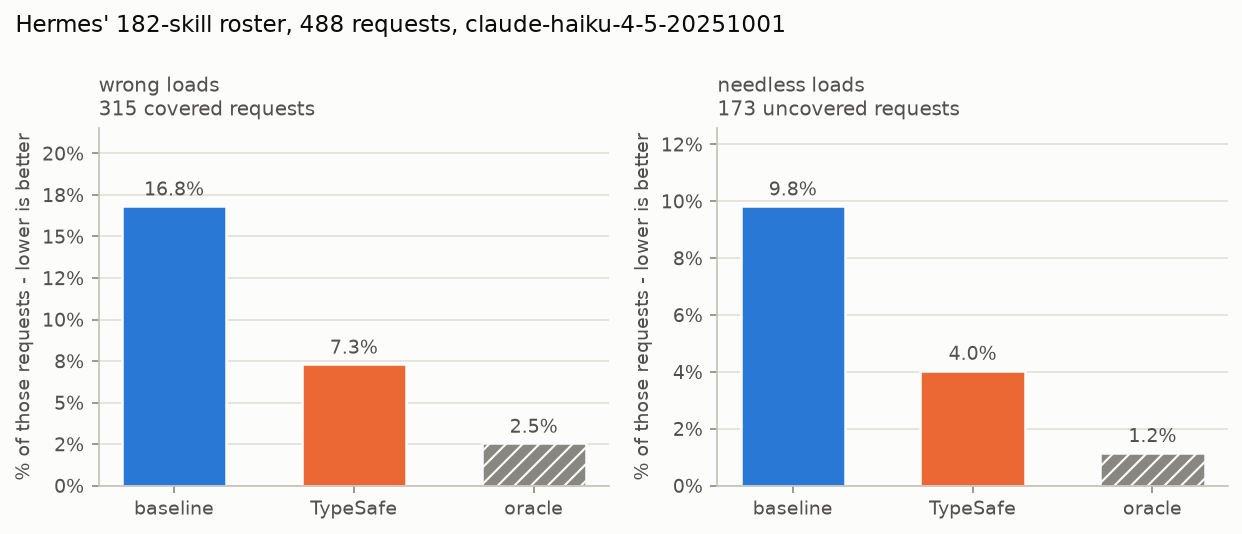
Что показывают результаты
- Доля ошибочных загрузок снизилась с 16.8% до 7.3%, а избыточных — с 9.8% до 4.0%, что покрывает
большую часть разрыва между угадыванием по усеченному индексу и идеальным знанием правильного ответа. - Некоторые запросы, которые агент решал верно самостоятельно, оказываются ошибочными при наличии
подсказки. Точные цифры приведены выше.
Используйте эту архитектуру, если ваш агент работает с обширным каталогом инструментов: недорогое
общее ранжирование всего списка, затем детальный анализ двух-трех лидеров. Любой из этапов может
закончиться решением ничего не загружать.
Открыть в песочнице
Сформируйте ссылку на песочницу для запроса о презентации из шага 4 с использованием полных
описаний кандидатов и фрагментов документации в качестве критериев.
demo_shortlist = tuple(name for name, _ in rank_wide(DEMO[1])["ranked"][:SHORTLIST])
playground_link = make_playground_link(
    build_state(DEMO[1]),
    rerank_questions(demo_shortlist, EXCERPT_CHARS),
    models=[TYPESAFE_MODEL],
)
display(
    Markdown(
        f"🔗 [Open the shortlist + questions in the TypeSafe playground]({playground_link})"
    )
)
Открыть шортлист + вопросы в песочнице TypeSafe →
Что дальше
Та же архитектурная схема применяется и в других руководствах:
Маршрутизация намерений (Intent Routing) для направления к
обработчику вместо навыка, Уверенность (Confidence) для
подбора пороговых значений, и
Speculative Fan-Out для объединения всех
вопросов в одном запросе.